Choosing granulator spare parts is not simply a matter of finding a component that fits into the available space. A knife, screen or fastening element must match the exact machine version, the processed material and the operating conditions. This guide explains how to compare original and compatible parts on technical grounds without confusing origin, quality or manufacturer responsibility.
What “original” and “compatible” mean
An original or OEM spare part is manufactured or supplied through the machine manufacturer’s authorised chain. A compatible spare part is made independently to perform a defined function and match specified dimensions. Compatible does not automatically mean inferior, but it is not the same as original: suitability must be demonstrated through drawings, materials, tolerances and inspection.
Sharp Industrial supplies compatible parts for applications identified by make and model where stated. All cited trademarks belong to their respective owners and are used solely to identify the intended application. A part must not be described as original unless its OEM origin is expressly documented.
Which components require precise identification
In a typical granulator, rotating knives work against stationary knives and a screen controls output size, as explained in the Rapid technical FAQ. The wear list extends further. NEUE HERBOLD lists rotor and stator knives, knife pressure bars, screens and screen inserts, V-belts, bearings, grinding discs and toothed rings among common spare and wear parts.
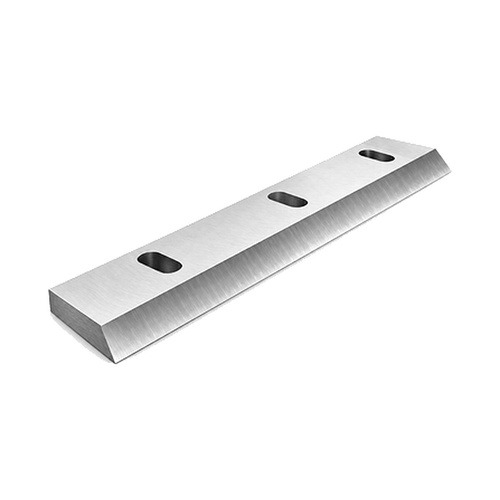
- Rotor and stator knives: geometry, bevel, flatness, holes and hardness affect setting and cutting.
- Screens: hole pattern, thickness, curvature and open area influence particle size and material flow.
- Pressure bars, knife holders and fasteners: they transmit load and must not be replaced on visual similarity alone.
- Bearings, belts and auxiliary items: use the correct reference, rating and specification from the manual.
Six checks before ordering a spare part
1. Complete machine data
Record manufacturer, model, serial number, year and, when available, rotor or cutting-chamber version. Two machines with the same commercial name may incorporate different revisions.
2. Component reference and revision
Find the number in the manual, exploded drawing or a previous invoice. If a drawing exists, confirm its revision. A number without a version can lead to a component that looks similar but is dimensionally wrong.
3. Measurable geometry
For knives, record length, width, thickness, hole diameters and positions, countersinks, bevel direction and angle. For screens, measure width, developed length, radius, thickness, pattern and perforation diameter. A photograph next to a ruler helps, but does not replace a drawing or physical sample.
4. Material and heat treatment
Request the steel grade, heat treatment, hardness range and surface treatment where relevant. Higher hardness is not automatically better: toughness, impact resistance, abrasion, metal contamination and resharpening potential must be balanced for the process.
5. Real operating conditions
State the polymer or other material, feed form, throughput, mineral fillers, moisture, contamination, temperature and desired output size. ZERMA’s spare-parts information also notes that screen size can affect machine performance.
6. Documented approval
Before producing a batch, confirm the drawing, critical tolerances, quantity, complete set and orientation. On a first order, a labelled used sample may resolve ambiguity, provided wear or deformation has not made reliable measurement impossible.
Why “it fits” is not enough
A knife may bolt into place yet create an unsuitable gap, project beyond the intended cutting circle or lose full support. The clearance between rotating and stationary knives must be set by qualified personnel using the machine manufacturer’s procedure and values. Never improvise tightening torques or replace screws by diameter and length alone: strength class, thread, seat, coating and condition matter.
A screen is not merely a filter. Perforation limits the discharged granule size, while thickness, open area and hole condition influence evacuation. If the required output changes, confirm that the new arrangement is approved for the rotor, material and installed power.
When each option may make sense
An original spare part is often the prudent choice during warranty, where undocumented revisions exist, for safety-sensitive assemblies or where the manufacturer’s contract requires it. Rapid, for example, describes its original spare parts as designed and quality-controlled for its own equipment. That is the manufacturer’s claim and should be evaluated alongside cost, lead time and service conditions.
A correctly specified compatible part may suit discontinued items, shorter lead-time requirements, repeat batches or material optimisation, provided the supplier validates dimensions, steel, treatment, hardness, traceability and inspection. Compare total cost: purchase price, service life, possible resharpenings, downtime risk and delivery time.
Incoming inspection and stock strategy
- Check quantity, identification and agreement with the purchase order.
- Inspect critical dimensions, flatness, holes, bevels, perforation and finish.
- Request material or hardness certificates when contractually required.
- Keep matched sets together and protect them from impact and corrosion.
- Install, set clearances and perform a manual rotation check according to the manual and with qualified personnel.
Classify stock by consumption, replenishment time and the consequence of downtime. Knives and screens may need complete sets; retain a labelled used sample and the approved drawing. Record hours, tonnes or cycles between changes so future comparisons rely on evidence rather than assumptions.
Requesting an accurate quotation
Send photographs, make, model, serial number, part reference, dimensions, quantity, processed material and the problem to be solved. Review our compatible spare parts, sharpening and technical services, or contact Sharp Industrial for an application review and quotation. Final validation must always be made against your machine documentation and actual operating conditions.